
Taken from UCLA Magazine: https://newsroom.ucla.edu/magazine/zodiac-boat-marine-operations-students
By Madeline Adamo | Photography by Ryan Young
It’s the sudden appearance of the alien-like “by-the-wind sailors” that first signals a potential something beneath the water’s surface. First, just a scattering of the translucent floating jellies, each about the size of a cookie. Then thousands.
A mysterious trail of bubbles and the presence of dozens of seabirds also tip off the crew of the UCLA Zodiac that what they’re searching for in Santa Monica Bay on this late May morning might finally be nearby. The sound of the motors softens as speed is reduced. All eight aboard get quiet.
The scene feels almost eerie as the 27-foot vessel cuts through the jellies and enters a “bait ball,” a dense aggregation of fish that attracts predators. Within minutes, the crew spots a seal, several dolphins, even a curious sunfish — a rare sighting. This one is about six feet wide, its strange body resembling a dolphin flattened by a steamroller.
As sensational as the scene is, it’s not the wildlife the students are studying, but rather the oceanic conditions beneath the surface. In this case, it’s “fronts” — narrow boundaries between bodies of water with different temperatures and densities — that the vessel’s acoustic Doppler current profiler is searching for. Something that bubbles, and that concentrated wildlife can sometimes signal.
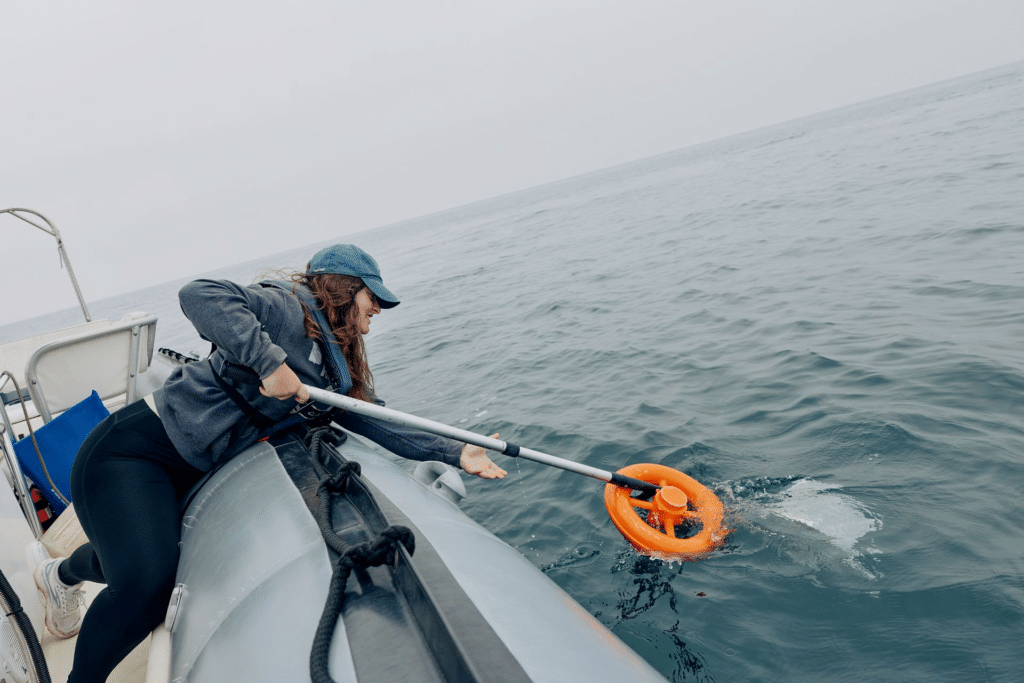
Photo Credit: Ryan Young
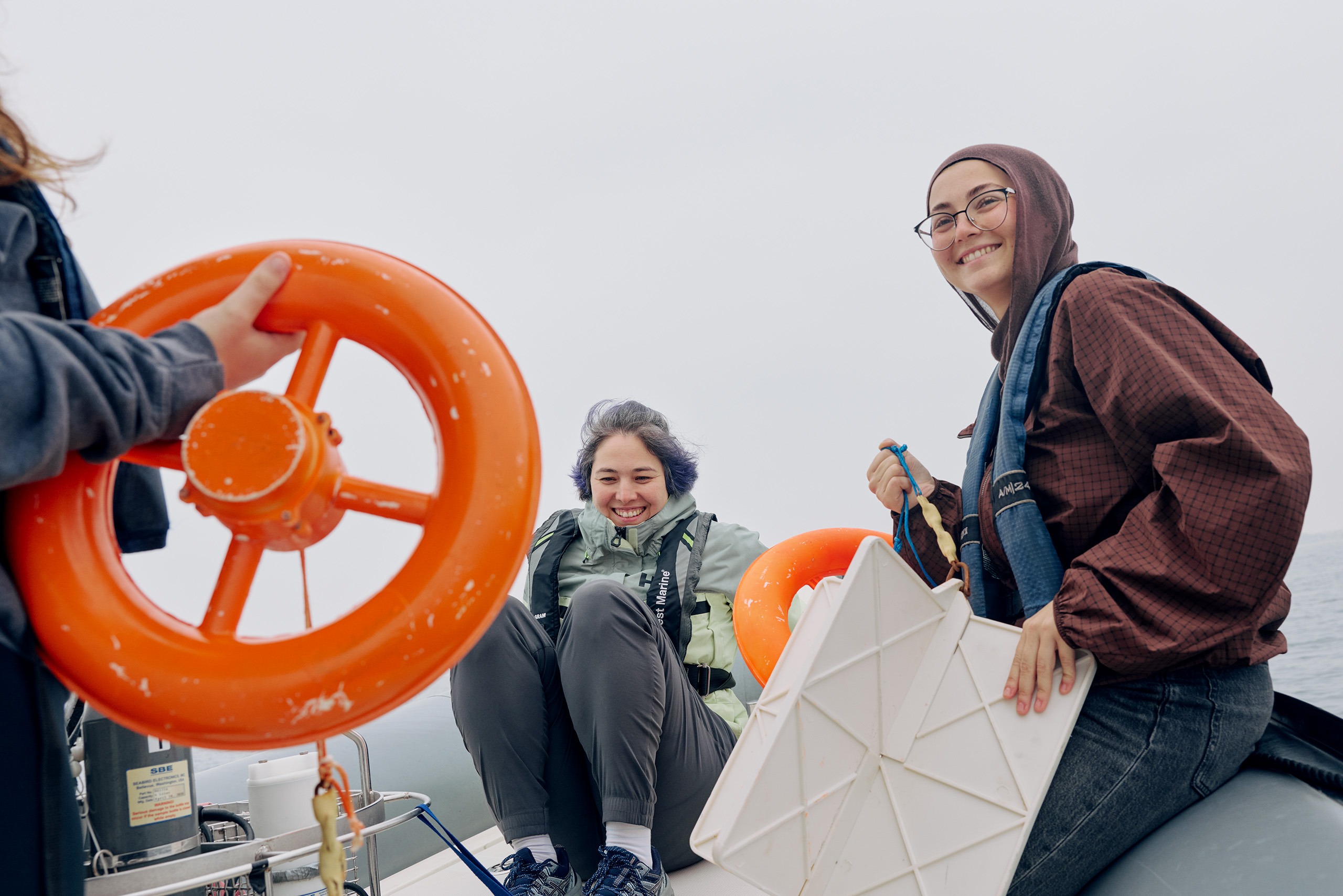
Fourth-year Anna Peterson, who is part of the UCLA Marine Operations program, uses a hook to retrieve a surface drogue that’s been collecting data. The orange float holds a satellite transponder that provides a position update on surface currents every five minutes.
Oceanographer Jeroen Molemaker, who launched UCLA’s Marine Operations program in 2014, beckons the crew over to a monitor synced with the profiler, an instrument that uses sound waves to measure water movement and currents deep below the boat. Molemaker jokes that while the Zodiac doesn’t have luxuries like a toilet, it does have state-of-the-art equipment. And a drone!
Today is more training exercise than active research mission: Operating the current profiler requires involved calibration and maneuvering. “We’re a floating lab,” Molemaker says. “Small, but mighty.”
Most Bruins don’t even know that UCLA has a research vessel docked in Marina Del Rey. And they almost certainly don’t know the overall operation is primarily operated by students — mostly undergraduates — who spend much of their week on the glassy waters of the bay overseeing instruments, collecting data and helping lead field trips for other UCLA classes.
Yuzuna Kudo switched from environmental science to atmospheric and oceanic sciences after just one cruise as a first-year student. And she isn’t the only one. “The research experience that I get through the program, I get to apply to what I’ve learned in the classroom,” she says. “I get to see how data is actually collected and analyzed rather than just reading about it in the textbooks.”
Kudo’s fellow crew members agree: What they hear most from undergraduates after their first trip is just how transformative it is to experience concepts from class out on the water.
Finish Reading from UCLA Magazine: https://newsroom.ucla.edu/magazine/zodiac-boat-marine-operations-students