
Last update: August 2025
We are currently recruiting participants for our study.
Please use the following link to sign up:
Rail (English): https://forms.gle/ceukU6iLz78rbeqv5
Rail (Spanish): https://forms.gle/9tmdB9nhB2KtPVpK7
LAX (English): https://forms.gle/Kct6SdXvU5sP3ncb9
LAX (Spanish): https://forms.gle/1ge8jn6RL1iXieXw8
FAQs:
What is the study about?
Outdoor air pollution is the 4th highest killer worldwide, and despite the enormous strides to cleaning up the air in Southern California, there is still more to do. This study is part of a larger product to understand the impact of rail, aircraft, electric vehicle charging stations and brake and tire wear particles on the quality of the air we breathe, and its impacts on our health, specifically on the health of newborn babies. The study is supported by the Health Effects Institute and the California Air Resources Board. The project has several stages, including collection of air pollution samples in residential back yards in areas that are impacted by one or more of these sources–or not at all impacted; we need clean urban sites as well. This will be followed by chemical and toxicity testing for these samples.
Who is involved and how will I find out the results?
The research team includes undergraduate and graduate students, professors and research staff from UCLA, Cal State Long Beach and the California Air Resources Board. We are working with community groups, libraries, city governments, individual volunteer residents and others throughout air pollution measurements phase of the study. Results of our measurements will be available at community group meetings, on our website and via individual communication.
More info and the health impacts of the pollution
The pollution data we collect will then be used to create estimates of pollutant levels throughout the greater Los Angeles area. For example, measurements near the rail lines in Pico Rivera and Commerce will be used to estimate pollutant levels near rail lines throughout Los Angeles, and measurements near LAX will be used to estimate pollution from LAX operations in the community. The measurements are specific; neighborhoods around LAX are impacted by high levels of pollutants called ultrafine particles, and a large area is impacted. Communities near rail lines MAY be impacted by higher levels of some heavy metals and black carbon, although we expect the impacts to be limited to an area very close to the rail lines. But we will not know until we measure it. None of these specific pollutants are routinely measured by the South Coast Air Quality Management District, which is the local authority in charge of measuring pollutant levels in our area. We have reason to believe that the ‘non traditional’ pollutants we are targeting will be better predictors of health outcomes than the ‘traditional pollutants’ like ozone and PM2.5.
The measured data will be combined with other data such as the locations of different industrial facilities, freeways, parks, etc. to create pollution maps. From the maps, we can estimate pollutant exposures for specific locations and for specific pollutants.
Later, we will use the maps to estimate exposures of pregnant women to several different pollutants. The exposure estimates will then be connected to birth outcomes, such as the incidence of pre-term birth and low birthweight babies.
The work will inform new policies created by the state of California to reduce impacts of air pollution on public health in a cost effective way, continuing the work carried out so far to clean the air while maintaining a vibrant economy in California.
Privacy
All data will be “de-identified”; no personal information or specific addresses will be disclosed. For example, the rail data will only be identified by the distance from the rail way and general neighborhood where the samples were collected. We are held to high standards in handling data that is in any way personally identifiable and are highly motivated to uphold these standards.
Here is an example of a map with sampling locations from an earlier study. As you can see, there is no way to identify the individual households where the samplers in that study were placed.
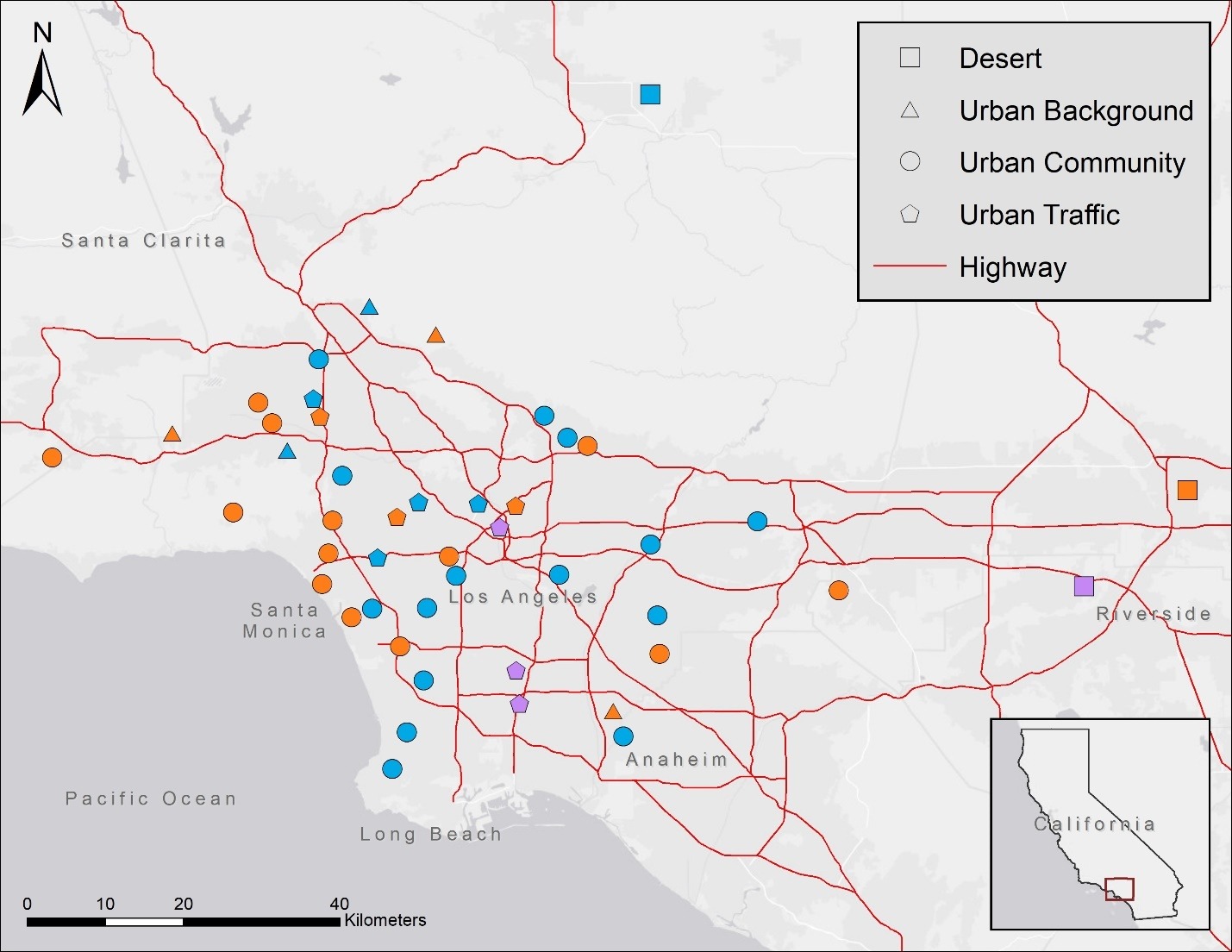
Location of the sampling sites in an earlier study in the Greater Los Angeles area for summer (orange), winter (blue), and repeated samples in summer and winter (purple)
Hosting a Sampler
If you agree to host a sampler, our friendly researchers will need to reach you to schedule a time to bring the sampler to your house, and to pick it up. We may also need to ask you to plug in the sampler at a certain time (if we cannot schedule all installations at the similar times–we need to collect several samples at different distances from the train tracks or at different locations around LAX). If you notice that you cannot hear the pumps (they are pretty quiet but not silent) we ask that you let us know. Also, in the event that there is a major wildfire or other unforeseen event, we might need to change the filters and start again, which might mean we need access to your space an additional time.
Thank you
As a thankyou for your time and a small amount of electricity (less than $5), we have a $150 visa gift card for volunteer residents.
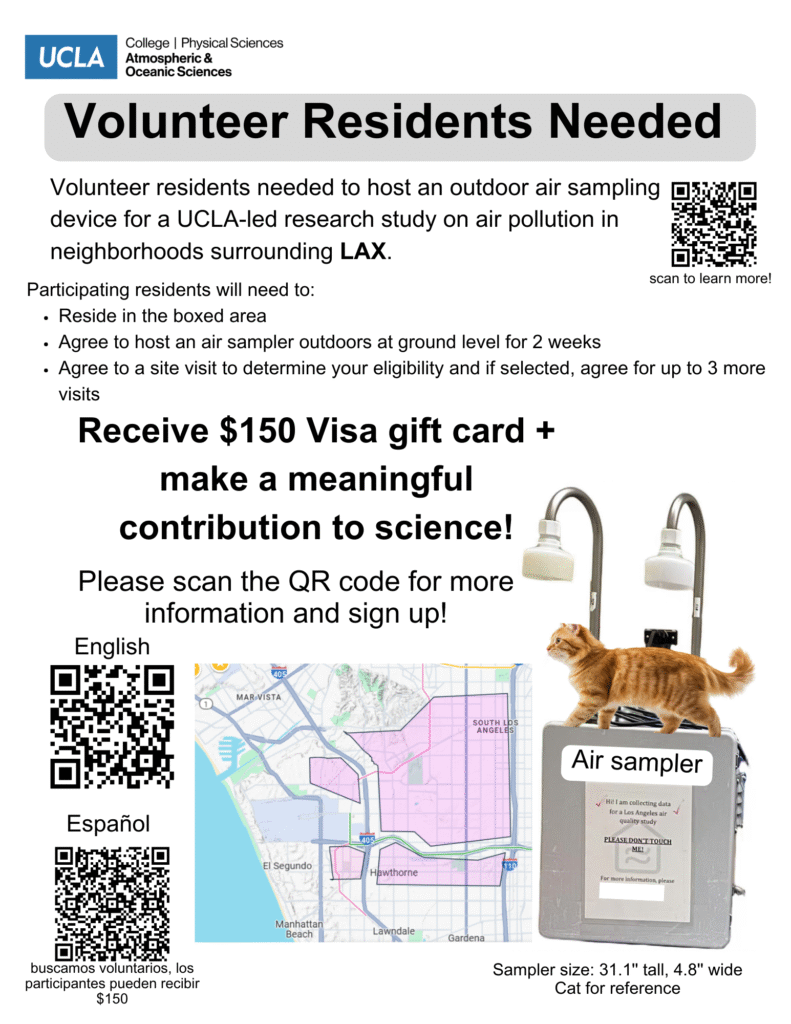
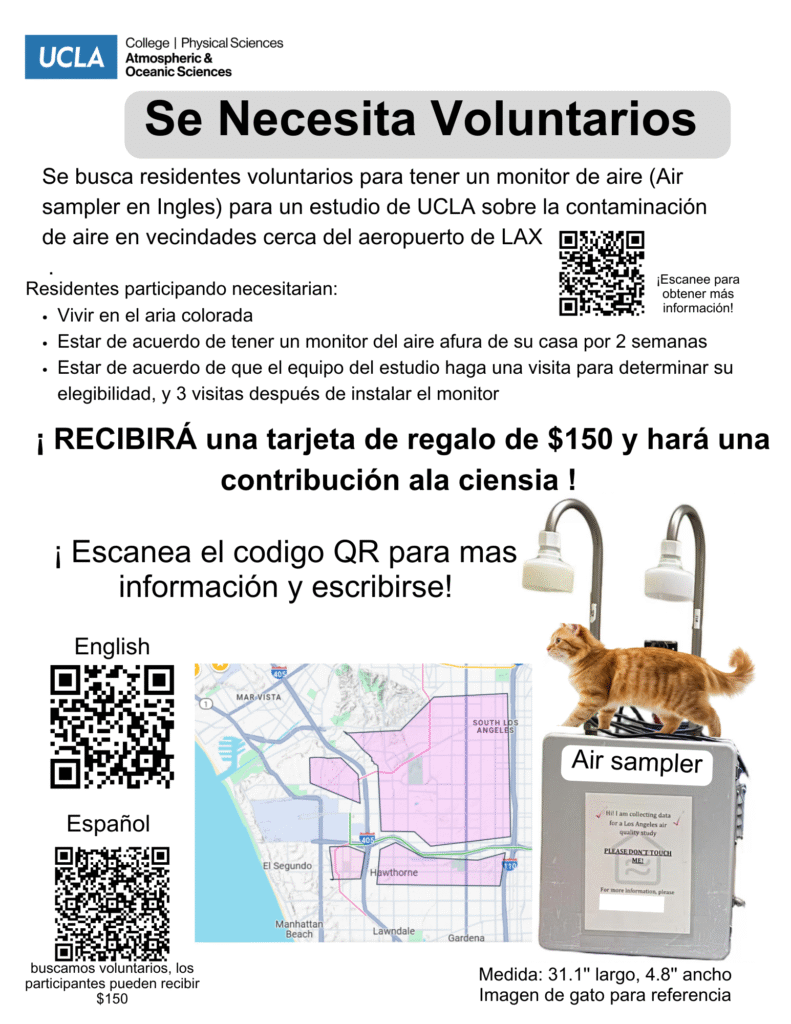
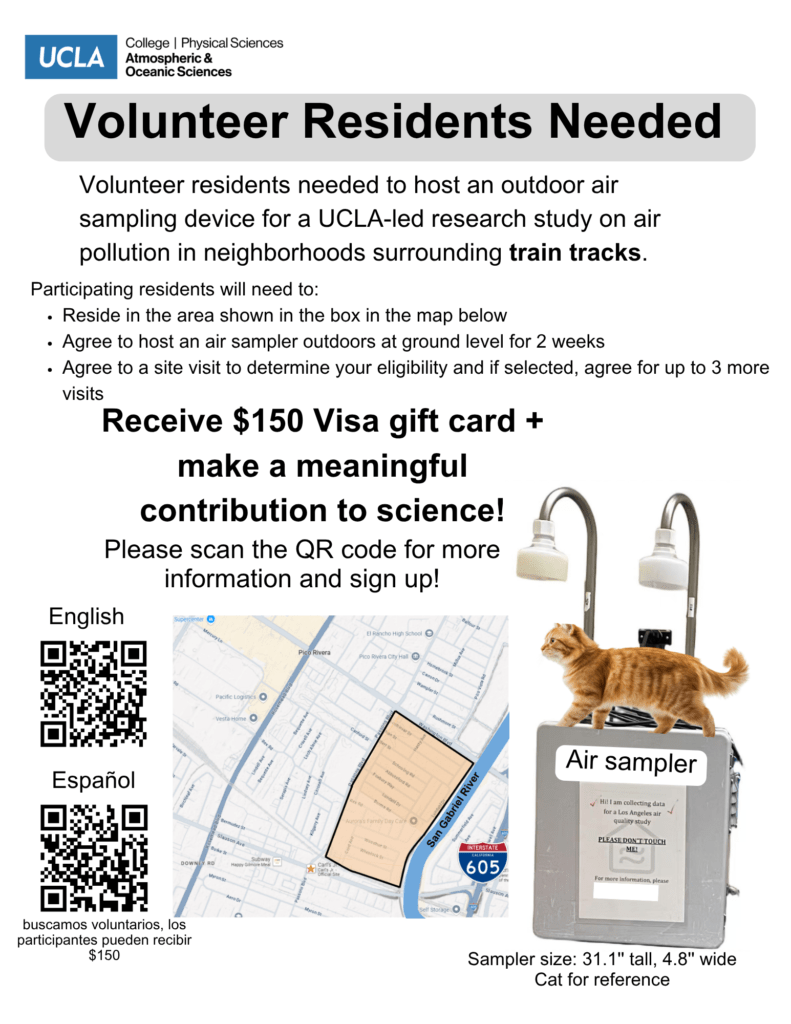
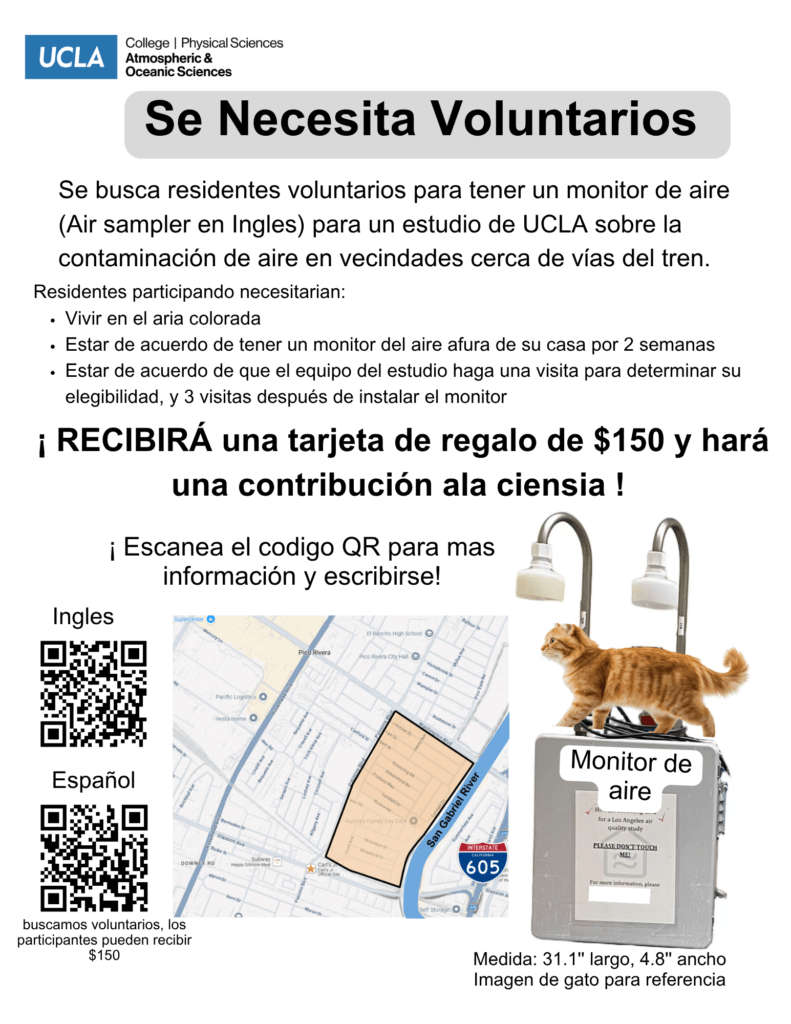
The cat is there to show the size of the sampler 🙂