
Research · UCLA Space Physics & AI Lab
From plasma waves to intelligent prediction.
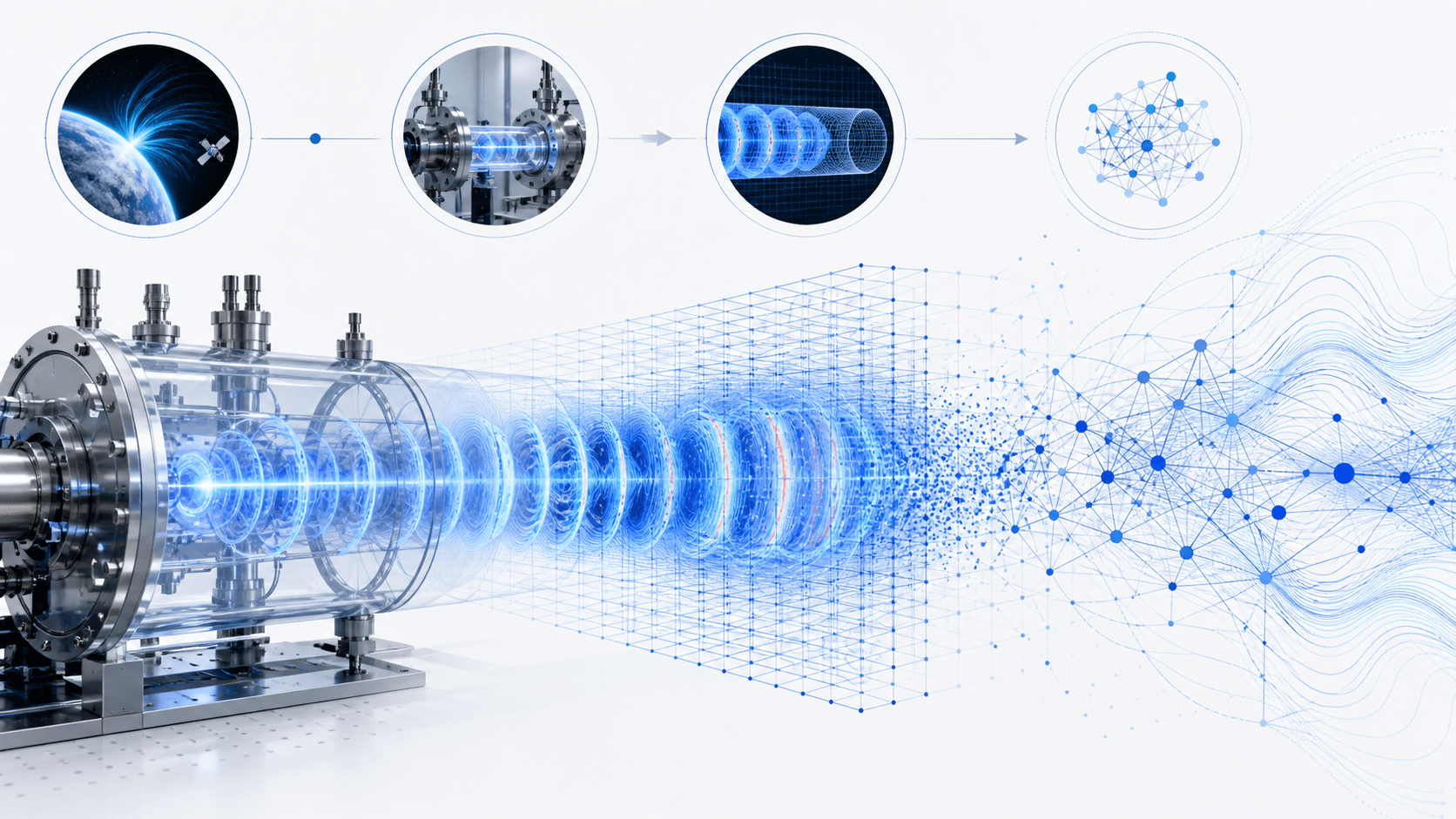
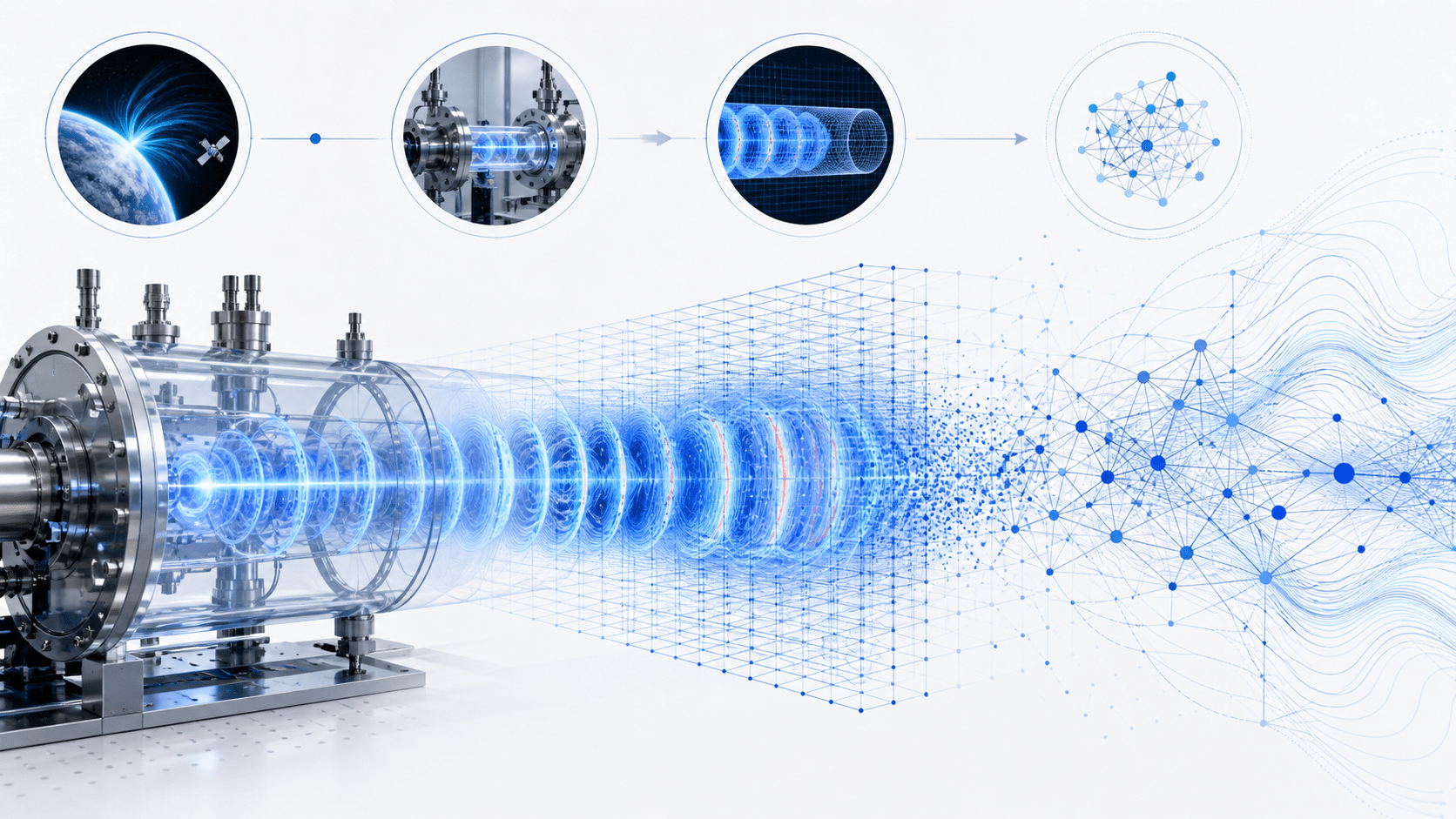
We investigate how plasma waves are born, how they travel, and how they exchange energy with charged particles. Our group connects first-principles physics with spacecraft observations, controlled experiments, numerical simulations, and machine intelligence to understand—and ultimately predict—the dynamic space environment.
WAVE–PARTICLE INTERACTIONS
PLASMA WAVES
LABORATORY EXPERIMENTS
NUMERICAL SIMULATION
MACHINE LEARNING & AI
01 · Fundamental physics
Particles, waves, and the energy between them.
Wave–particle interactions
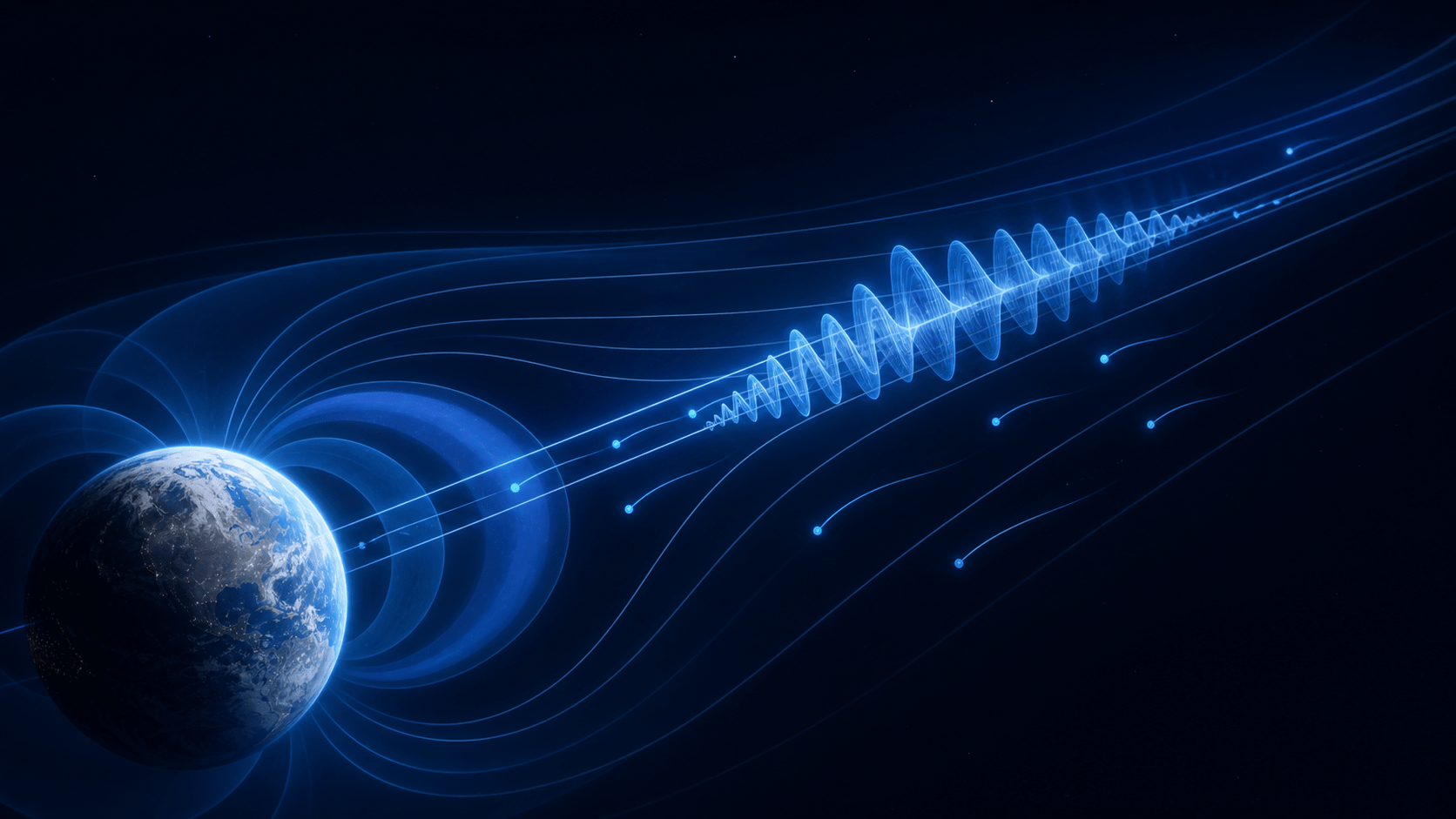
Energetic particles and plasma waves continually exchange energy. We study the resonant and nonlinear processes that accelerate radiation-belt electrons, scatter particles into the atmosphere, and shape auroral emissions. The goal is to connect microscopic interactions with system-scale behavior.
Plasma-wave excitation, propagation, and distribution
We ask where waves are generated, how they refract and propagate through an inhomogeneous magnetosphere, and why they become intense in some regions and quiet in others. Our work spans chorus, plasmaspheric hiss, electromagnetic ion cyclotron waves, magnetosonic waves, and related emissions that regulate energetic particles from Earth to Jupiter.
02 · A connected toolkit
The same question, tested four ways.
OBSERVE
Spacecraft data
Multi-mission measurements reveal particles and waves across locations, energies, and timescales.
ISOLATE
Laboratory plasma experiments
Controlled experiments reproduce key features of wave generation and particle scattering so individual mechanisms can be tested directly.
SIMULATE
Numerical models
Theory, particle tracing, diffusion models, and large-scale simulations connect local interactions to evolving magnetospheric systems.
LEARN
Machine intelligence
Data-driven models reconstruct missing structure, identify physical drivers, and make complex environments more predictable.
03 · Machine learning & AI
AI as a scientific instrument.
We use machine learning to do more than make accurate forecasts. Our models reconstruct global, time-dependent plasma environments from sparse measurements gathered by moving spacecraft; specify energetic-particle conditions across energy, location, and time; and help distinguish the physical drivers of enhancement, loss, and quiet intervals.
Projects such as the ORIENT radiation-belt model demonstrate the path from fundamental research to usable space-weather capability. At the same time, interpretable and physics-informed AI turns model behavior back into testable scientific questions—an approach we are extending across space science and the physical sciences more broadly.
RECONSTRUCT · INTERPRET · PREDICT · DISCOVER
One program · many scales
Discovery moves in both directions.
Measurements motivate theory. Experiments isolate mechanisms. Simulations connect scales. AI reveals patterns and raises new physical questions. Together, these methods let us move from the smallest resonant interaction to the behavior of an entire magnetosphere—and from explanation toward prediction.
Next layer
Projects & publications
The next iteration will connect each research theme to current projects, representative papers, datasets, software, and the people leading the work.