The UCLA Zodiac and its myriad array of on-board instruments have primarily been designed to measure oceanic phenomena that can be collectively grouped under the moniker of ‘submesocales.’ Submesoscales characterize dynamical features in the ocean that typically have sizes less than 10km (though this number varies significantly with Latitude) in the horizontal and are often concentrated near the ocean surface. These submesoscale features, the most common manifestations of which are fronts and eddies, are short lived with approximate time periods that range from a few hours to a few days. Therefore to measure these features accurately and characterize their dynamical evolution, a fast deployment vessel like the Zodiac is ideal.
The Zodiac has three fundamental instrumental units that taken together are typically only found on larger oceanographic vessels, making this a unique platform for its size class. A surface sampler measures the surface Temperature, Salinity, Chlorophyll and dissolved Carbon dioxide concentrations at the ocean surface, which can be viewed live, on the ship computer as the measurements are being conducted. Often sharp transitions in Temperature and Salinity, a hallmark of oceanic fronts, can be viewed immediately, leading to a focused deployment of the other instruments on board for more in-depth measurements.
Once a feature, like a front, is located through the live surface sampler, a Towed Instrument Array (TIA) can be deployed at the stern of the Zodiac. The TIA consists of a line of instruments, that are placed at about half-meter vertical intervals, measuring temperature and salinity to depths as deep as 30m. Finally, a fast-sampling (up to 16 times a second) Acoustic Doppler Current Profiler measures the speed of the ocean currents to depths of 20m. Both the TIA and the ADCP can be deployed while the Zodiac is moving at speeds as high as 10 knots.
Knowledge of the ocean currents, together with the temperature and salinity allows a detailed and high-resolution (in both space and time) reconstruction of the vertical structure of upper ocean submesoscales, a critical step in understanding their physics.
Kaushik Srinivasan
Past Cruises
EAGER Santa Monica Bay Sampling
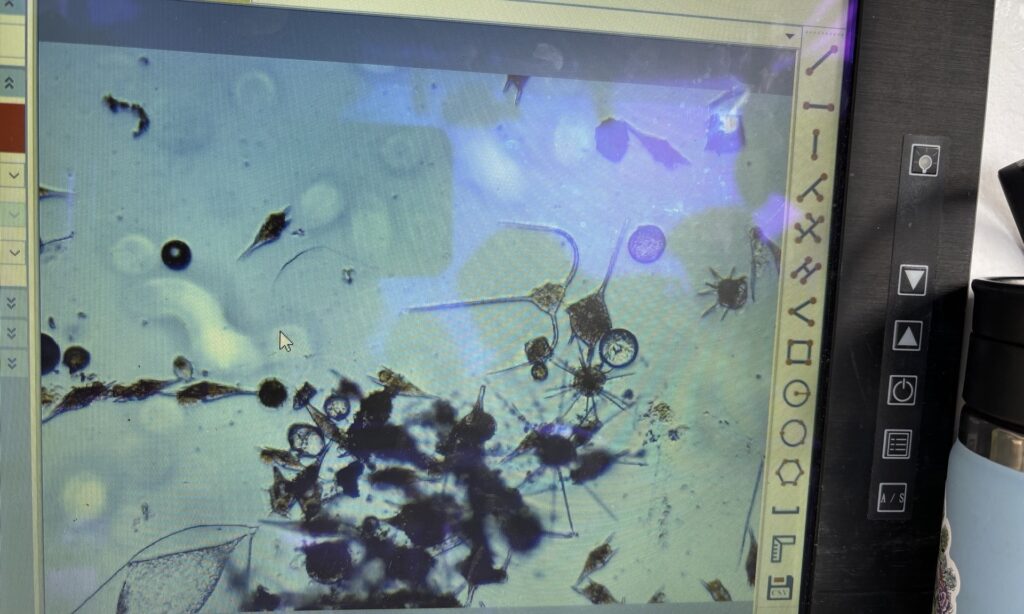
Since December of 2021, the Zodiac has worked with Dr. Rob Eagle’s biological oceanography lab to conduct monthly cruises for EAGER, a project that aims to collect physical, chemical, and biological data relating to phytoplankton blooms at two locations in the Santa Monica Bay. This is done in order to relate observed changes in plankton community structure to these parameters as well as to establish a dataset for students in oceanography courses at UCLA to analyze through worksheets and projects. These cruises also give undergraduate students an opportunity to join the cruises and assist with field work.
SPLASH: Grand Isle, Louisiana
In the spring of 2017, the Marine Operations team spent three weeks doing field research in the Gulf of Mexico. Based out of Grand Isle, Louisiana, we worked with a team of over 40 scientists from 14 universities and research institutes around the world. Our time there was spent collecting as much useful data as we could. We deployed and tracked over 400 GPS equipped biodegradable drifters and collected data from a ship-mounted ADCP, a drifting ADCP, a towed instrument array outfitted with temperature, conductivity and pressure loggers, and a surface sampler with continuous temperature and salinity data. This campaign was the fourth and final field expedition within CARTHE, the Consortium for Advanced Research on the Transport of Hydrocarbon in the Environment.
eDNA: Channel Islands
In the summer of 2017, Marine Operations partnered with Zach Gold, a Marine Biology PhD candidate, and his research team to help them obtain DNA samples as part of his thesis. For about 10 days, we transformed our research zodiak into an eDNA lab, collecting and filtering water from various locations in and around the Marine Protected Areas of Santa Cruz and Anacapa Islands.
Research Instruments
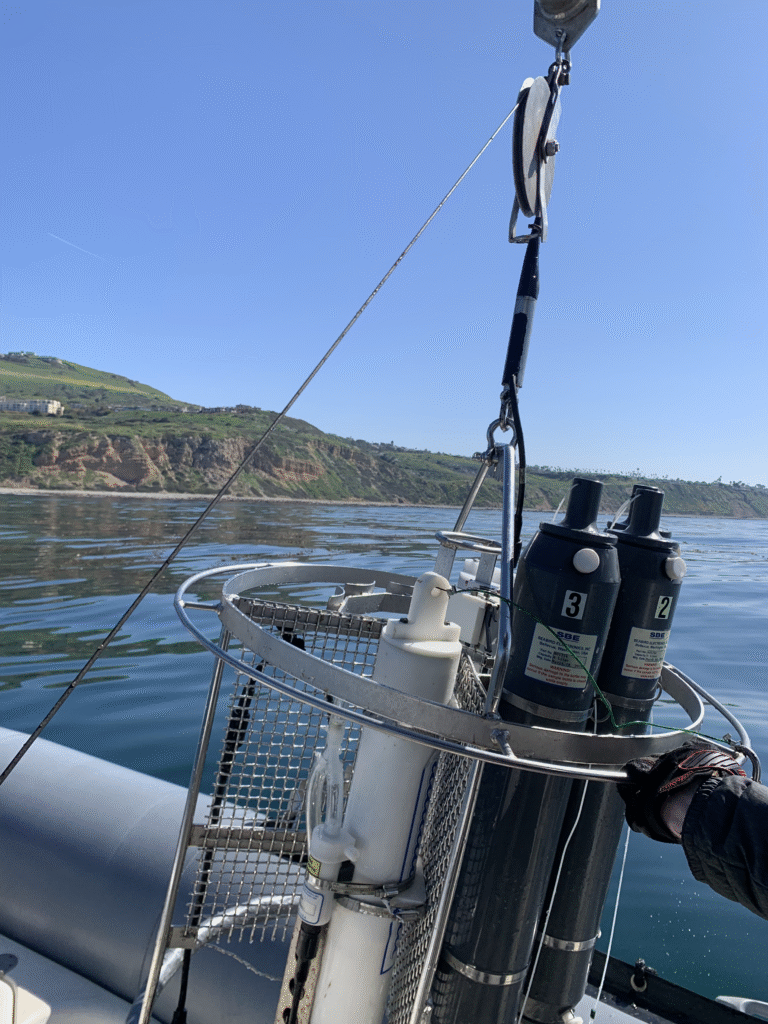
Rosette Sampler: Consisting of 3 4-liter niskin bottles and a CTD attached to a frame, the rosette sampler can be lowered down into the water column to provide real time temperature, salinity, and depth data, as well as to collect water samples at a desired depth up to 600 meters.
- SBE 33 Carousel Deck Unit
- SBE 55 ECO Water Sampler
- SBE 19+ SEACAT Profiler CTD
Zodiac Pro 850
- 28 ft
- Repurposed fishing boat customized for maritime research
- Twin Yamaha 150 HP
Acoustic Doppler Current Profiler: The ADCP gives a vertical profile of current velocities in the water column. It uses the Doppler shift by sending out sound pings and based off the returning signal, it creates an image of the ocean currents’ velocities.
- Workhorse mariner 300kHz
- Workhorse Sentinel 300 kHz
- Nortek
Thermosalinograph: Provides continuous measurements of the temperature and salinity of surface water via a flow-through system.
- Sea-Bird Electronics (SBE) 45 MicroTSG Thermosalinograph
Fluorometer: Uses fluorescence to calculate biological productivity readings via a flow-through system.
- WetLabs WetStar
Towed Instrument Array Loggers: Data loggers measuring temperature, conductivity, salinity, depth, pressure, and dissolved oxygen.
- RBR TDR-2050 temperature depth logger
- RBR TR- 1050 Temperature logger
- RBR Solo- temperaturer logger
- RBR Duo- Temperature depth
- RBR XR-CTD conductivity, temp, depth, dissolved oxygen
- JFE- Conductivity temp
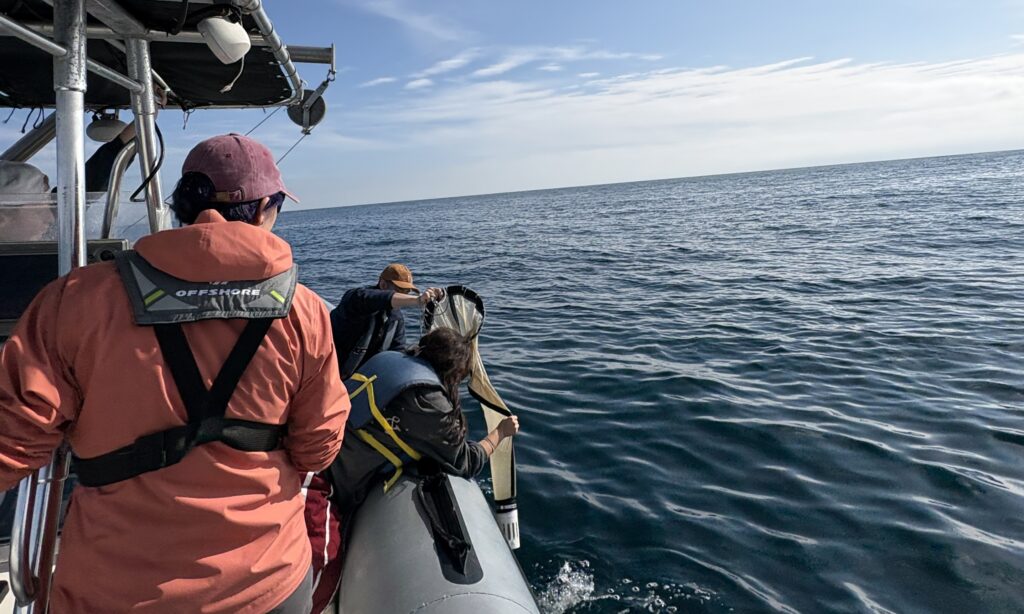
Plankton Net: Collects plankton samples while being towed alongside the boat by filtering water through a 53 micrometer mesh net.