
Mickaël D. Chekroun
Researcher
Ph. D in Mathematics
mchekroun@atmos.ucla.edu
Research Interests
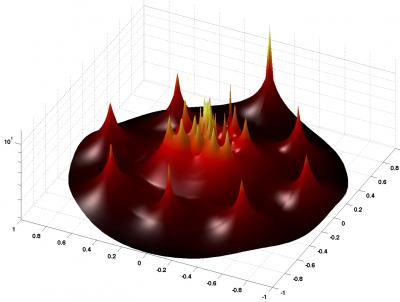
Modes of Variability:
- Kolmogorov modes of jump-diffusion models
- Data-adaptive harmonic modes
- Ruelle-Pollicott resonances, correlations and power spectra
- Characterization of stochastic nonlinear oscillations
Stochastic Non-equilibrium Systems:
- Non-Markovian reduced models to unravel transitions
- Stochastic transitions in non-equilibrium systems
- Stochastic invariant manifolds for SPDEs
- Stampacchia Maximum Principle for SPDEs
Data-driven Equations Discovery:
- Data-driven stochastic models and the Koopman operator
- Data-driven networks of stochastic nonlinear oscillators
- Data-driven non-Markovian closure models
Closure of Multiscale Systems:
- Non-Markovian reduced models to unravel transitions
- Anticipating tipping points and higher-order critical transitions
- Variational approach to closure of nonlinear dynamics
- Fast oscillations and balance motions in reduced primitive equations
- Stochastic rectification of slow manifold closures
- Stochastic nonlinear oscillator models of jet-eddy interactions
Response Theory/Optimal Control:
- Linear response of jump-diffusion models
- Jump-diffusion induced chaos in high-dimension
- Detecting and attributing change in climate and complex systems
- Rough parameter dependence and Ruelle-Pollicott resonances
- Finite-horizon parametrizing manifolds for optimal control reduction
Time-Delay Systems:
- Shear-induced chaos and model’s variability enhancement
- SNO bifurcation, tipping solution paths, and ENSO variability
- Hopf bifurcations in cloud-rain delay models
- Galerkin-Koornwinder approximations
- Optimal control of delay equations
Machine Learning for Complex Systems:
- Turbulence closure with small, local neural networks
- The high-frequency and rare events barriers to neural closures
Critical Transitions:
- Non-Markovian reduced models to unravel transitions
- Stochastic transitions in non-equilibrium systems
- Anticipating tipping points and higher-order critical transitions
- Pullback Attractor Crisis
Applications to Earth Science (selected):
- Detecting and attributing change in climate and complex systems
- Gibbs states and Brownian models for haze and cloud droplets
- Theoretical tools for climate crisis and Hasselmann’s program revisited
- Opposing trends of cloud coverage over land and ocean
- Past-noise forecasting of ENSO
- Data-driven stochastic modeling of Arctic sea ice
- Low-order reduced models of GCM datasets
- Low-order reduced models of Madden-Julian oscillation
- Paleoclimate stochastic models
- Stochastic climate dynamics and random attractors
Turbulence Closure with Small, Neural Networks:
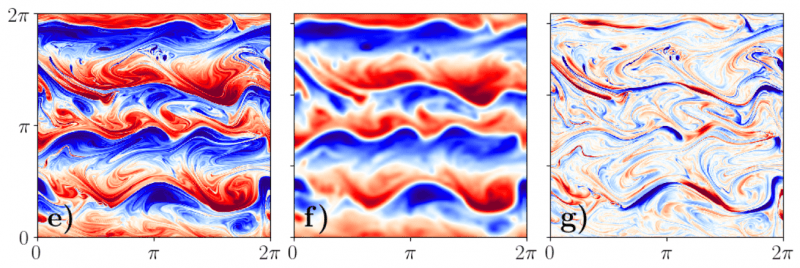
Vimeo movie: https://vimeo.com/824681438
Stochastic Strange Attractor (Chekroun et al. (2011), Physica D, 240):
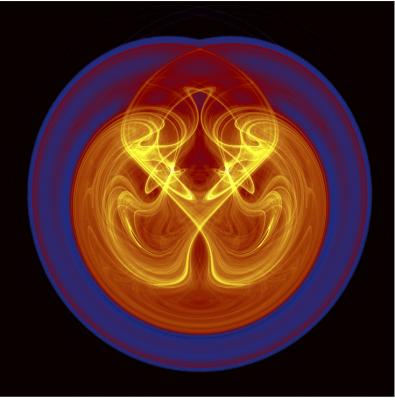
Vimeo movie: https://vimeo.com/240039610
Cloud Physics and Stochastic Strange Attractors (Chekroun et al. (2022), Science Advances, 8 (46)):
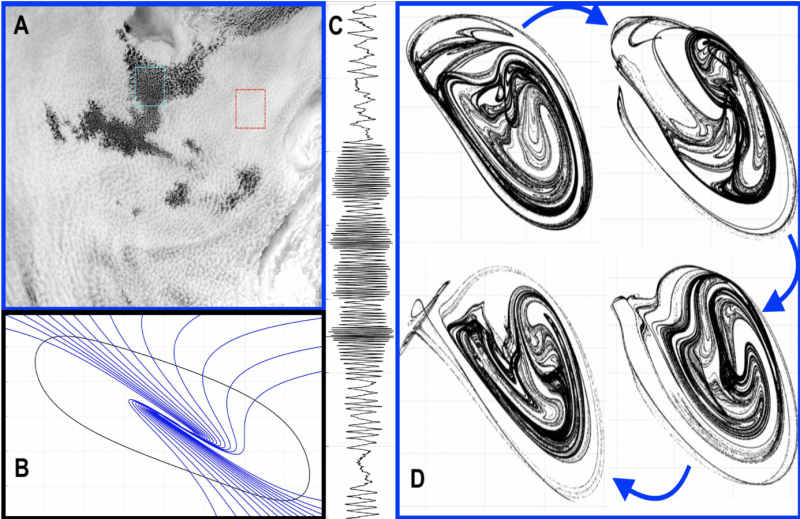
Vimeo movie: https://vimeo.com/773696444