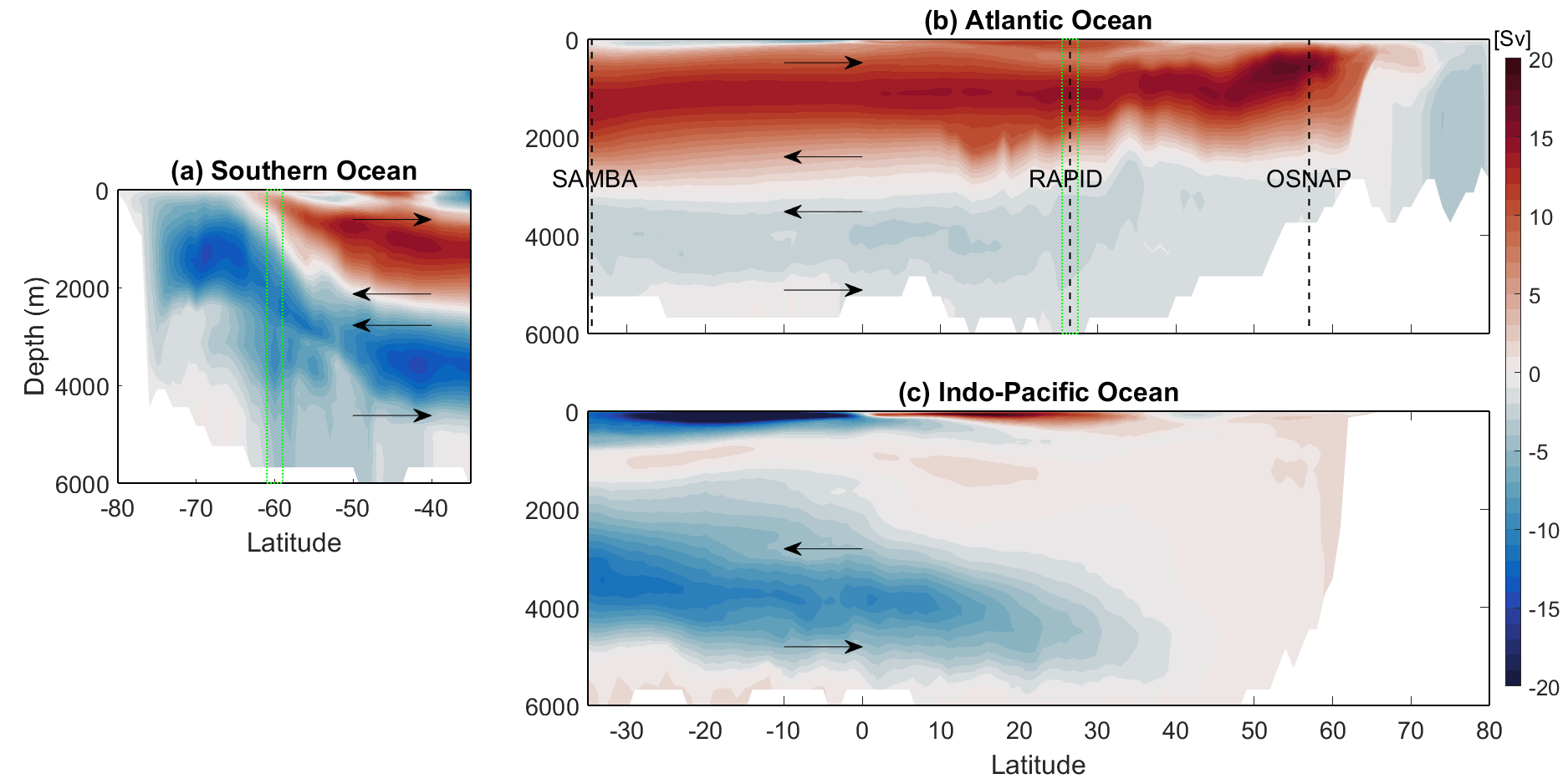
The ocean’s meridional overturning circulation (MOC) is a key component of the climate system, transferring mass, heat and chemical tracers between all of the major ocean basins. However, direct measurements of the MOC remain confined to a few locations in the Atlantic (see figure below). A possible means of circumventing these observational limitations is to utilize satellite-based measurements, for example of sea surface height, and ocean bottom pressure, to indirectly observe MOC variability. To date such efforts have focused on the latitude of the established observational arrays in the Atlantic.
In this project we will use Machine Learning (ML)-based approaches to infer MOC variability throughout the global ocean. We will develop these approaches using a suite of realistic ocean/climate simulations, ranging from IPCC-class future climate projections to global high-resolution ocean/sea ice simulations. We will apply ML interpretability techniques to evaluate which satellite observables are most closely linked to MOC variability, and in which geographical regions, and identify additional hydrographic measurements that could effectively augment a satellite-based approach to inferring MOC variability. Finally, we will adapt our ML approach to the frequency and spatial resolution of NASA satellite products, evaluate any resulting changes in predictability, and construct MOC time series from the available satellite record.
This work is supported by the National Aeronautics and Space Administration (NASA) ROSES Physical Oceanography program under grant number 80NSSC23K0357.