Last updated: 09/03/26
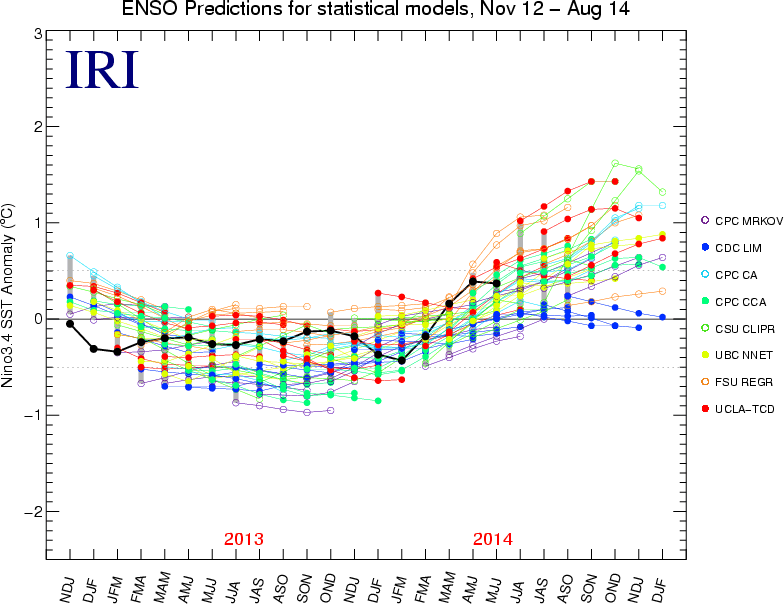
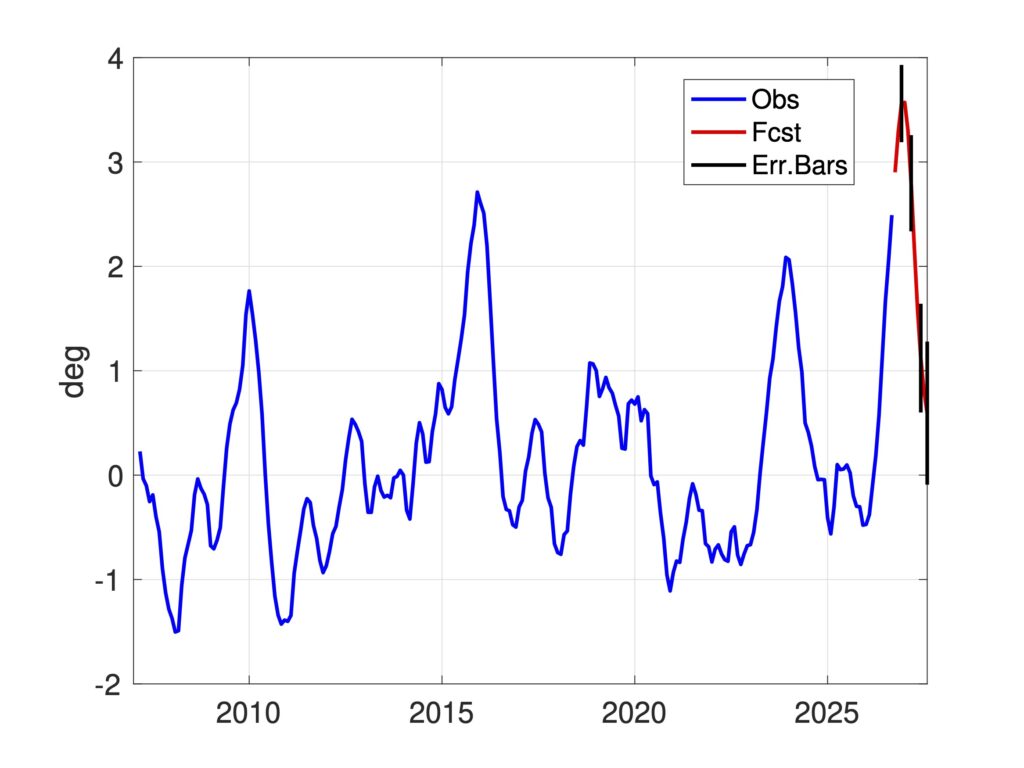
The NINO-34 stochastic ensemble forecast by Empirical Model Reduction approach (Kondrashov et al. 2005) is based on SST data from January 1950 through August 2026 (blue), and ensemble mean (red) predicts strong El-Nino conditions by the end of 2026. The error bars (black) correspond to one standard deviation of the ensemble plume. You can also check a multi-model plume of Nino-34 forecasts from different statistical and dynamical models maintained by IRI, and compare predictions for the past 22 months, including also the UCLA-TCD model. Independent analysis of real-time 2002-2024 forecast skill of IRI multi-model plume of Nino-34 forecasts shows that UCLA-TCD model is highly competitive, see see Barnston et al. (2012, Fig. 6) for skill during the 2002–2011 interval and Zhao et al. (2024, Fig. 2m) for 2002–2022, respectively.
References
- Kondrashov, D., S. Kravtsov, A. W. Robertson and M. Ghil, 2005: A hierarchy of data-based ENSO models. J. Climate, 18, 4425–4444, doi: 10.1175/JCLI3567.1
- 2. Kravtsov S., D. Kondrashov, and M. Ghil, 2005: Multi-level regression modeling of nonlinear processes: Derivation and applications to climatic variability. J. Climate, 18, 4404–4424, doi: 10.1175/JCLI3544.1
- S. Kravtsov, D. Kondrashov and M. Ghil, 2009: Empirical Model Reduction and the Modeling Hierarchy in Climate Dynamics, invited chapter in Stochastic Physics and Climate Modeling, (T. Palmer and P. Williams, Eds.) Cambridge Univ. Press, pp. 35–72.